What is a room data sheet – in the past and today
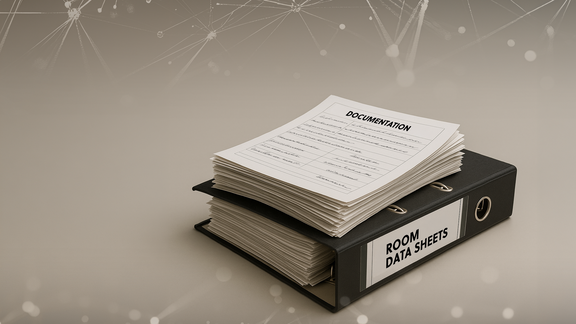
The use of a room data sheet is not a new idea in itself. However, the traditional role of a room data sheet was more to document the inventory and condition of a room or to serve as an appendix to planning documents. These appendices were then available as static lists—initially in paper form, later as tables in Excel or PDF format—and were either intended to document the status of planning or, in the best case, to provide a description of the final state of a plan.
The approach of creating a consistent information model, on the other hand, is relatively new. Instead of planning status, the focus shifts to the life cycle, consisting of conception, planning, construction, and operation. Together with the machine readability of data, which is not just a "nice extra" but a declared goal of this information model, this approach has only been systematically pursued for a few years. Versions of a digital room data sheet in the BIM workflow were first mentioned in studies, guidelines, and pilot projects in the early 2020s.
Advanced software for managing digital room data sheets has been available for some time, particularly in large-scale property planning and facility management. However, digital room data sheets as a conscious, BIM-integrated, and life-cycle-oriented approach have only recently become the subject of broad discussion, particularly in German-speaking countries, and did not receive a formal normative framework until the publication of VDI 6070 in 2024.
However, not every customer project is a large-scale project with over 1,000 rooms or more than 50,000 m² of gross floor area, where the implementation and training costs of such high-priced tools are worthwhile. In principle, however, a room data sheet is useful even if you're only planning one room. That's why we need a tool that is easy to use and integrates seamlessly with existing software: the Room Data Sheet Module for LINEAR Building.
Before we go into more detail, let's first take a closer look at the general use of a digital room data sheet and its benefits.
Benefits and Use Cases of a Digital Room Data Sheet
Since the digital room data sheet is used throughout the entire life cycle, but its benefits change over time, we have grouped our analysis into the areas of concept/requirements planning, design/planning, execution, and operation.
During the concept/requirements planning phase
| Target: | Gather the requirements for the building to be constructed in a structured and model-independent way. |
| Added value: | The room data sheet functions like a specification sheet in table form" that is later linked to the model. The requirements are not “hidden” in protocols etc., but remain machine-verifiable." |
| Among other things, functional areas are defined here (depending on the building type), e.g.: |
• Office and Administrative Building: primary use/tasks, communication/collaboration, representation/reception, service/support, residence, catering, technology, logistics • Educational Buildings: teaching/instruction, after school care/supervision, sports/physical activity, administration, community/public space • Hospital: patient care, diagnostics, therapy, emergency care, service, logistics/catering, administration, technology |
| Among other things, room types are defined here (depending on the building type), e.g.: | • Individual offices, group offices, meeting rooms, entrance hall, IT/server rooms, break rooms, building services rooms, classrooms, after school care, cafeteria, ... |
| Among other things, quantities and target values are specified here, e.g.: |
• Room areas by room type (Individual office 12–14 m², classroom 60–70 m², ...) • Room areas by room type and person (Offices: 12 m²/person, patient room: 10 m²/person, classroom: 2.5 m²/student, …) • Maximum occupancy per room max. 30 people in the classroom, max. 4 people per group office) • Number of sanitary facilities • Temperature target values • Air quality (minimum air exchange rate, CO₂ limits, ...) • Acoustic limits (reverberation time, sound insulation between areas, ...) • Lighting (illuminance, proportion of daylight/window area ratio, ...) • Electrical (number of power and network sockets, connection values, ...) • Media supply (water, wastewater, compressed air, oxygen, ...) • Energy (max. 40 W/m²) |
During the design/planning phase
| Target 1: | The room data sheet becomes the central reference document (for specialist planning). |
| Added value 1: | The room data sheet becomes the central source of information for room data, while the BIM model provides the geometric view. Together, these two elements form a consistent information model. |
| This is how it works: | At the latest after synchronizing the rooms in the room data sheet with the rooms in the model, it is possible to perform an automatic plausibility and consistency check—ranging from very simple" (Are all rooms in the room data sheet represented in the model?) to more complex, rule-based checks (Are the requirements for the rooms met?)." |
| Target 2: | Avoiding the "information gap." |
| Added value 2: | Once data has been gathered, it does not disappear into a "black hole" but can be reused purposefully in the planning process. In addition to preventing copy-and-paste errors, this also saves a lot of time and effort. |
| This is how it works: | By saving the data in a machine-readable format with unique identifiers (each value has a unique name or key), different applications (design tools, load calculations, design software, tests) and project participants (from architecture, planning, execution, facility management) can access the same values. If these change, the updated values will be available everywhere again. The data is provided either via synchronization steps (room data sheet model) or via direct access to the data (within the room data sheet application or in a CDE platform). |
And beyond planning
| During the execution planning and for the handover to operations or facility management, there are many other possible uses, which will only be briefly outlined here: |
• Identification of patterns in rooms for execution (efficiency through repetition effects) • Change management (logging changes) • Inspection and defect management • Information for management and service (maintenance, cleaning, ...) • etc. |
The role of the LINEAR Room Data Sheet Module
At this stage, it would be presumptuous to describe the new LINEAR Room Data Sheet Module as a life cycle-oriented digital room data sheet. What is still missing, in particular, is detailed change management: Who changed what, when, where was it discussed, and who initiated the change? However, this also increases the administrative workload for all those involved in the project. For simplified handling, the LINEAR Room Data Sheet Model already offers a low-threshold entry into the next stage of planning.
The Room Data Sheet Module is a very powerful tool that is always available and easy to use, especially during the design and planning phase of buildings. In addition, it is not necessary to agree on a shared tool with all project participants. The above-mentioned goals can be achieved with the Room Data Sheet Module, which provides the respective added values.
Furthermore, thanks to its close integration with LINEAR Solutions, the Room Data Sheet Module offers significant advantages over external solutions: Many features already work automatically or are particularly easy to configure. For example, many "value keys" – we call them "parameter names" – are already known, and it is therefore clear how their values are to be processed. This includes, among other things, occupancy, room temperatures, heating and cooling loads, and room equipment (e.g., plumbing, electrical, GA). The values can then be used in follow-up planning with LINEAR Solutions. Whether for schematic concepts using the scheme generators, for the design modules for radiators, radiant heating and cooling, or air diffusers, or for the development of a model-based pipe route concept.
Integrated AI support can help to quickly make plausible assumptions when information is missing—which is bound to happen. That way, assumptions are not just guesses or tedious estimates. It can also assist with validation by comparing the values it provides with the existing ones as a "second opinion".
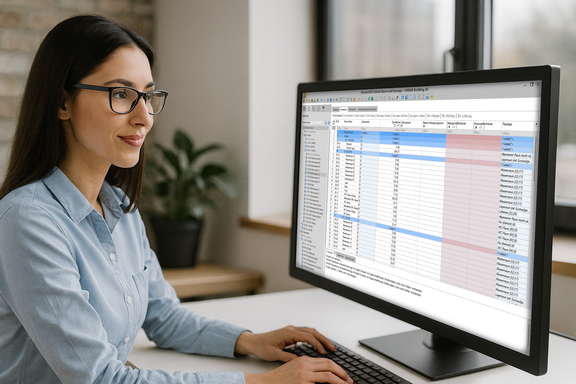
Even for those who are unfamiliar with the concept of a digital room data sheet, the module offers unprecedented clarity and simplicity when entering room data. For example, you can easily display an overview of the target room temperatures with the corresponding heating and cooling loads and their coverage ratios grouped by room type. Outliers in the target temperatures can thus be identified and adjusted immediately if necessary, without having to leave the view.
And all those who recognize the full potential and want to carry out future planning supported by room data sheets now have an easy way to get started. You can obtain information for planning from the architectural office or BIM management even before the first proverbial "stroke of the pen." To do this, please forward an Excel spreadsheet with the corresponding columns, which may also be empty. As planning progresses, the density and quality of information can be gradually increased, for example by using the model as an exchange platform or additional Excel files for data exchange—with a "single source of truth" for room data of whatever kind.
Conclusion
The digital room data sheet is evolving from what used to be an "appendix" consisting of static lists into a comprehensive information model and management tool that structurally links requirements, planning, and subsequent use. It ensures transparency, particularly in the design and planning stages, reduces friction between those involved, and keeps information consistent for reuse instead of it getting scattered or lost during the project.
For future projects, it is therefore worthwhile to consider the digital room data sheet at an early stage and to use it consistently: ideally, not only once the model is ready, but already during requirements planning as a shared, machine-readable basis. Those who start small—even with a lean structure at first—can gradually increase the density and quality of information, thereby laying the foundation for more efficient, verifiable, and robust planning processes. In short: The digital room data sheet is a pragmatic means of gaining planning security—and a useful standard that should be established from the outset in future projects.
PS: Even if you end up having to fill a folder with room data sheets in the traditional way, this can of course also be automated on the basis of structured data.