The first two articles in this series on "District Heating” initially focused on the role of municipal (local/district) heating networks in decarbonizing the heat supply—including key drivers such as municipal heat planning, funding frameworks, and the question of suitable technical solutions. (blog article „Municipal local heating networks to decarbonize the heat supply“). Building on this, we demonstrated the specific challenges that the upcoming wave of expansion poses for technical planning: increasing complexity, dynamic constraints, high precision requirements, level of detail, and feasibility – and thus a clear need for powerful planning tools. (blog article „Bright Times for Designing the District Heating Networks of Tomorrow“)
This third article picks up exactly where the previous one left off and focuses on practical implementation in the planning process: It describes how local heating networks are planned using the specialized software LINEAR Analyse District Heating for calculation and design—from structured network layout and hydraulic calculations to detailed, construction-ready designs. In addition to the software's features, this section highlights its unique selling points compared to other solutions by examining a typical planning workflow—particularly in areas where traditional "early-phase tools" reach their limits and where end-to-end planning up to execution is required, with high transparency and the ability to respond quickly to changes.
Which tasks is LINEAR Analyse District Heating best suited for?
The software is designed for the technical planning of local and district heating networks – specifically for the stage in which a network concept is transformed into a calculable, execution-ready CAD model. A key benefit is the combination of CAD-based modeling and reliable network calculation based on field-proven rules and design logic, which were incorporated into the development process through the collaboration between LINEAR and REHAU. This creates a seamless workflow from pipe route planning through material selection to the creation of plans optimized for the construction site. In particular, REHAU contributes the perspective gained from real-world projects as well as its expertise in polymer-based local heating systems—with the goal of ensuring that the calculations and the actual execution in the model are consistent with one another.
It is important to clarify: This tool is not intended as a conceptual decision-making aid for the early planning/strategy phase of local or district heating projects (e.g., choosing between a local or district heating network and individual heating systems, rough investment estimates, or selecting service areas). However, it does support cost and quality optimization within a selected network concept through precise sizing, variant calculations, plausibility checks, and material- and execution-specific network layout.
Example Workflow: From pipe route to a design ready for execution
A typical project can be best described using a practical workflow, without getting into every single detail of the steps involved. The key point is: LINEAR Analyse District Heating guides you from the very beginning to automatically create a computable model from your drawing, including ongoing validation and clear feedback on missing information.
It all starts with “on-site planning.” The project is set up with geodetic accuracy (e.g., ETRS89/UTM) so that the aerial image and map background align precisely and the resulting pipe route corresponds to the real-world road network. Depending on the region and the level of detail required, you can switch between different map styles: Aerial view showing the actual street layout, or a map view for orientation. In addition, digital topographic maps and geodata are used to automatically import geodetic elevations into the model and to derive an elevation profile. This step is crucial for network design, as differences in elevation directly affect the required pressure level and, consequently, the assessment of critical network sections. The inclusion of location and elevation data thus enhances the reliability of the calculation from the outset and facilitates its later application to the construction site.
The pipe route design is based on this. The route is created efficiently and systematically using specialized drawing tools, in such a way that a computable network model is generated directly from it. The CAD-based workflow uses Autodesk AutoCAD, an established platform that is already in use at many planning offices. At the same time, even at this early stage, rules for geometry and data entry serve as guidelines, such as material-dependent constraints like minimum bend radii. This reduces typical follow-up errors that would otherwise only become apparent late in the execution process – and at great cost.
In the next step, a simple line drawing is transformed into a network of technical objects. To do this, feed-in points, transfer stations, branches and other network components are placed as elements. This object-oriented approach is crucial: Components carry properties and uniquely represent nodes and transitions. It is precisely this clean modeling logic that ensures that calculations, evaluations, and material lists will function reliably later on—not as post-editing, but as a direct result of the modeling process.
Once the network has been set up as a model, network detection and data validation start. This is where LINEAR Analyse District Heating really shines. The network is automatically checked when the calculation starts. Missing or implausible data points are written into a report and can be selected directly in the model using the "Show" button. This creates a highly practical workflow: check, identify, correct, and continue working—without having to spend time searching through the project and with clear documentation of any unresolved issues.
The data entry system is designed to remain scalable, whether for small neighbourhoods or larger municipal networks.. Performance data and design parameters are collected for each component—depending on the workflow, either via property panels or component lists with filtering and sorting logic. This is particularly helpful when the project involves different types of buildings that need to be handled in groups: for example, different building categories (renovated vs. new buildings), different connection scenarios, or simultaneity. The simultaneity approaches are not rigid but can be adapted on a regional basis. In addition, the component list remains closely linked to the CAD model: When you select an item from the list, you are taken directly to the object on the plan, allowing you to maintain a visual reference at all times.

Once data collection is complete, you can perform the calculation – and this is where the quality of the model and data logic really pays off. The configuration takes into account actual material properties and employs proven dimensioning strategies derived from REHAU’s decades of experience in district heating network systems. Critical issues, such as excessive flow velocities or unacceptable pressure conditions, are not only logged in the report but can also be highlighted in the model. Visualizations—such as color-coded representations of nominal diameters – make problematic areas easy to spot and ensure a comprehensive assessment of the plan.
A key benefit then arises from the ability to create variants and optimize the design. In real-world projects, conditions often change: Pipe routes are adjusted, pressure setpoints are modified, additional generators are considered, or network sections are to be meshed. LINEAR Analyse District Heating is designed to incorporate such changes into a new, dependable calculation without any disruption. This allows for the targeted use of meshing or ring main closure to reduce flow velocities and increase network stability. It is also possible to map multiple feed-in points with defined shares. This is a key consideration for realistic expansion and transition pathways, in which networks grow gradually and renewable energy generators are integrated step by step. In addition, material scenarios can be evaluated, for example by adding additional pipe systems and implementing automatic material changes based on the determined dimensions. This is where REHAU's system expertise comes into play, particularly in cases where material-specific constraints (e.g., bending radii, delivery forms/bundled coil lengths, component logic) affect design feasibility and material allocation.
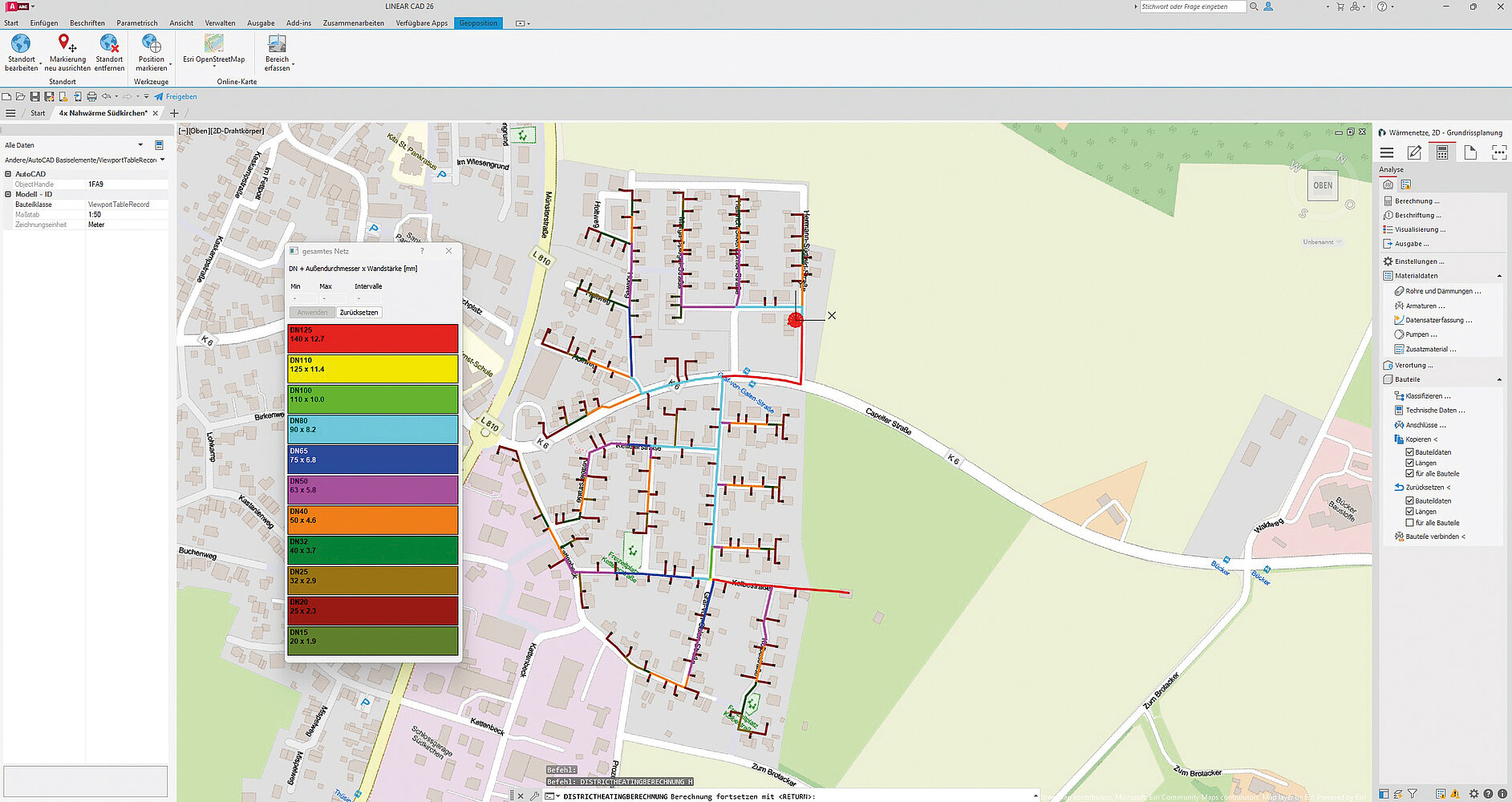
The workflow concludes with material take-off and plan derivation—the link between the calculation and the construction site. Material take-offs can be generated from the model either in full or selectively, for example, in sections for construction phases, progress payments, or purchase orders. Tools for drawing frames, scales, labels, and customization are available for documentation and printing for the construction site. Labels remain dynamic and update automatically when performing calculations. This means the tool doesn't only perform hydraulic calculations, but consistently supports the execution-ready material and layout logic, including positioning.
Other strengths that often go unnoticed in the workflow
A major advantage of LINEAR Analyse District Heating is its seamless integration into the existing LINEAR environment. For users who are already working with LINEAR, this means: familiar operating logic, consistent data management, and minimal adjustment required. At the same time, new users also benefit from a clearly structured, CAD-like workflow that perfectly mirrors the way planning offices operate.
Furthermore, the software solution is not only intended for “greenfield” projects. Especially in a municipal context, it is often necessary to expand networks in stages, retrofit pipe sections, or validate and expand existing networks. This logic is built into the tool—both in terms of modeling as well as comparing variants and deriving material.
Data import and export are also important for collaboration with clients, utility providers, or GIS environments. This is an aspect that plays a key role in quality assurance for larger projects.
After all, LINEAR Analyse District Heating is designed for teamwork and standardization: Cross-project settings can be defined as office standards and can be shared. At the same time, the necessary flexibility is maintained to make project-specific “fine-tuning”—right down to individual nodes, junctions, or building connections.
Summary and Conclusion
The software specifically addresses the gap between an "idea of a network" and "detailed planning": It enables CAD-based, professionally verifiable, and optimizable heating network planning with a high degree of transparency—from georeferenced pipe routes and component-specific data collection to robust error and plausibility checks, as well as variant calculations (meshing, feed-in, materials), detailed material lists, and plans suitable for the construction site.
This means it is not a tool for making fundamental conceptual decisions in local and district heat planning, but rather a highly effective tool for the precise planning, cost optimization, and readiness for implementation of a selected network concept – especially in projects with dynamic constraints and expansion paths.
The key difference from many early-stage tools is its consistent focus on readiness for implementation, supported by the combination of LINEAR’s expertise in planning software and REHAU’s practical experience, as well as material system know-how, which is incorporated into the dimensioning logic, material data, and system mapping.
Release: Early May 2026, Version 26.1.