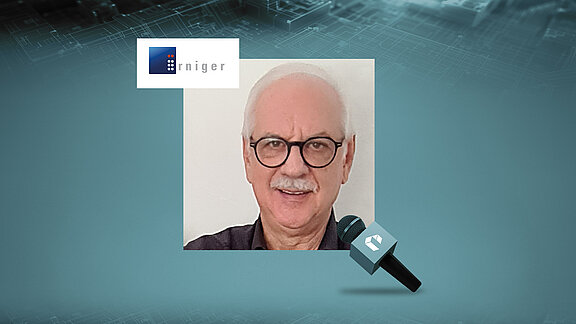
LINEAR: Please briefly introduce yourself and your company. What are the main areas of focus in your service offerings?
Dario Irniger: I originally trained as a heating engineer. Immediately after my apprenticeship, I decided to pursue a part-time degree in mechanical engineering (FH) at the Higher Technical College in Zurich, which I successfully completed in 1980.
LINEAR: Can you give us an overview of the company’s history and explain the direction in which your company aims to develop in the future?
Dario Irniger: In 1989, I founded Ingenieurbüro Irniger as a sole proprietorship. In 1993, it was converted into a corporation. Since 1974, I have been active in various technical fields and have gained extensive experience—including in chemical process engineering, apparatus and power plant construction, machine tool and fixture manufacturing, industrial plant construction, the plastics processing industry, and hot water and steam heating plants. This expertise has been incorporated into approximately 420 completed projects and is highly valued by our clients.
In 2020, my son Renato joined the company. He also studied mechanical engineering and earned a master’s degree in business administration. We work very well together, and our scope of operations now extends beyond national borders. How our company develops in the future will be determined primarily by the needs of our clients. One thing is clear, however: we must continuously adapt to the digital environment and remain open to new technologies.
LINEAR: Is there a project you’re particularly proud of?
Dario Irniger: There are several projects I’m particularly proud of. However, I’d like to highlight one, even though it was several years ago: the construction of a new factory near St. Pölten in Austria for a well-known sanitaryware group. The project spanned three years, from 1989 to 1992. The design took place in Switzerland, while the technical construction management was handled on-site in Austria.
In addition to all building services systems (TGA), I also designed the cooling water system for the injection molding machines as well as the utilization of the resulting waste heat for heating purposes. The chillers used were the first of their performance class in all of Europe at the time to feature screw compressors and were manufactured specifically for this facility. I was pleasantly surprised at the time that the architect involved me early on in the design of the new factory building. As a result, all parts of the building were connected via an accessible, underground utility tunnel that provides access to all areas from the energy centers. Additionally, I was tasked with designing the machine layout and material flow for the hall housing the injection molding machines, including the plastic granulate system.
What made this project exceptional for me was not only the technical challenge, but also the experience of working in a neighboring country and getting to know different standards and regulatory requirements. Above all, however, it was the first time I had the opportunity to work with so many dedicated people outside of Switzerland. This led to friendships that continue to this day. Looking back, this period was one of the most rewarding phases of my professional career.
LINEAR: What role do sustainability and climate protection play in your projects?
Dario Irniger: Sustainability and climate protection are becoming increasingly important in our projects. In recent years, the number of renovation projects in which fossil fuel heating systems are being replaced by non-fossil fuel solutions has risen significantly. In industry, too, requirements in this area have noticeably increased. We therefore consistently examine where, for example, waste heat can be put to good use to make processes more efficient. In doing so, we place great emphasis on ensuring that the chosen measures deliver measurable, tangible benefits—in a pragmatic and solution-oriented manner, free from ideology.
LINEAR: “Digitalization” remains a hot topic—even within the construction industry. Do you see opportunities and/or challenges in this?
Dario Irniger: I’d prefer not to speak in terms of “opportunities” or “challenges” here, but rather to report on our daily work with digital design tools in the BIM context.
In the design phase, BIM fundamentally enables significantly more precise coordination: models make dependencies and conflicts visible early on and support coordination between trades. However, it is crucial that the benefits of the BIM methodology are actually utilized by all parties involved—meaning that not only are models created, but processes, roles, and responsibilities are also clearly defined, and everyone consistently works with the most current information. Only then can BIM truly realize its potential.
In practice, we find that implementation can involve additional effort depending on the project and project team. Creating 3D models and Revit families can be very time-consuming, and the interfaces for model exchange do not always function smoothly throughout the process. This makes common standards, clear exchange formats, and high-quality data across all stakeholders all the more important. On construction sites, it is also evident that large-format paper plans are still frequently used and valued—often because they are readily available and immediately readable by everyone. At the same time, digital use on-site gains value when it is adopted by everyone and processes are aligned accordingly.
Here’s an example to illustrate this: Three years ago, we had a construction project that was consistently implemented on a digital basis. Nevertheless, an important riser zone for the building services was built 1.58 m narrower than specified. The consequences for redesigning the building services shortly before installation were significant. In our view, such experiences demonstrate above all that BIM is particularly effective when all project participants actively embrace the method—with clear communication, binding checks, and consistent use of digital information all the way to the construction site.
LINEAR: What significant changes have you observed in the industry in recent years?
Dario Irniger: In recent years, we have observed several significant changes in the industry—with opportunities, but also with risks.
On the one hand, we view with concern the fact that political mandates and legal frameworks are increasingly influencing highly technical matters. When there is a lack of understanding regarding practical implementation, this results in requirements that are well-intentioned on paper but difficult to implement in reality, or that cause disproportionate and, in some cases, largely ineffective additional effort.
On the other hand, we note that intense price pressure has noticeably impacted both the quality of system components and, in particular, the execution of installations. What is concerning here is not so much a single error, but the trend that specialized knowledge is no longer available everywhere at the necessary depth, and that interrelationships in complex systems are consequently sometimes viewed with insufficient holistic perspective.
In our view, the great opportunity lies in consistently returning to sound technical expertise, thorough design, and high-quality execution. If we focus more closely on the physical fundamentals and implement them correctly in practice, we can realize sustainable, efficient, and long-term solutions even under new requirements.
LINEAR: In your opinion, how has the introduction of BIM affected the design, coordination, and execution of construction projects?
Dario Irniger: Our experience shows that 3D modeling is increasingly used in many projects today, and model exchange often takes place on an IFC basis. However, consistently implemented BIM design—that is, with clearly defined processes, roles, information requirements, and consistent use of the models—is still rarely explicitly required in our projects.
We see two main reasons for this: First, modeling—depending on the desired level of detail—is very time-consuming. Second, the added value of BIM depends heavily on whether all project participants have the necessary experience, the appropriate standards, and the corresponding technical equipment. If these conditions are met and everyone is on board, BIM can significantly improve coordination and make design errors visible earlier. If they are not, the result is often limited to “3D with data exchange,” without the full potential of the methodology being realized.
LINEAR: You rely on our LINEAR solutions for project management. What has your experience been like so far with the software? What sets our solutions apart in your view, and how have they helped you make your workflows more effective?
Dario Irniger: We have had very positive experiences with LINEAR GmbH’s solutions, particularly in plant engineering. The supplementary tools—such as the tank generator and the extensive component library—in particular provide tangible support in helping us build models more precisely while maintaining efficiency. In our workflow, the LINEAR tools are an ideal complement to the functions of the base software: They expand the standard capabilities precisely where the level of detail and data quality are critical in building services and plant engineering. This allows us to perform many steps in a more structured and faster manner, improve model quality, and make workflows more effective overall.
LINEAR: What motivated you to invest in LINEAR back then?
Dario Irniger: What motivated me to invest in LINEAR back then was, above all, that I was offered a very coherent and practical all-in-one package for MEP design right from the start, and this continues to impress me to this day.
The continuous development of the software is also particularly important to me. I greatly appreciate that users’ practical experiences are taken seriously and visibly incorporated into the development process. Equally crucial for me is support that responds quickly and provides assistance without long wait times when it matters most. I have been working with LINEAR software since 1989 and remain very satisfied to this day. I was LINEAR’s first customer in Switzerland back then. This long-standing partnership is also a sign to me that the solution has reliably grown with us over many years and works effectively in practice. What’s particularly worth mentioning is that I’ve been supported by Mr. Sven Hailer both then and now. Over the years, this has been a major advantage for me: we know each other, understand the practical requirements, and I always feel well supported—whether it’s with day-to-day questions or new developments and topics.
LINEAR: If you had one wish to simplify future building design, what would it be?
Dario Irniger: If I had one wish, it would be for an exchange data format that can be adopted truly seamlessly—in other words, a format that can be integrated into the respective design process without time-consuming post-processing or adaptation work. I also wish that 3D design would be streamlined to focus more on the essentials and consistently align with the actual scope of the project. BIM should be used where it provides clear added value, not as an end in itself.
LINEAR: The shortage of skilled workers is one of the current and future challenges that companies must face. What motivated you back then to choose this industry, and what advice would you give to young (aspiring) professionals who are (or want to) pursue this path?
Dario Irniger: I get the impression that today’s younger generation expects significantly more flexible work models. Companies are therefore well advised to actively develop and offer such models—also to effectively counteract the shortage of skilled workers.
What personally motivated me to return to this industry is a longer story. The decisive factor was above all my fascination with industrial plant and pipeline construction. Over time, “general building services engineering”—as I’d like to summarize it here—also emerged as another exciting field. To young, aspiring professionals, I can offer one piece of advice above all else: Try to understand what you’re doing and why. Learn to recognize and truly grasp the interconnections within complex systems. And draw on the experience of seasoned professionals: Ask questions and actively seek out this knowledge.
LINEAR: Do you have any suggestions or requests you’d like to share with us?
Dario Irniger: Yes. We have a few suggestions, primarily regarding Revit, that we believe would provide real added value in practice:
- A component generator for shell-and-tube heat exchangers and one for plate heat exchangers—for both brazed and bolted designs.
- An extension of the existing vessel generator, for example, to include the option of feet on the shell or, alternatively, a base ring.
In addition, various suspension systems with an automatic docking function on the tube shell would be a real asset—especially for piping design, because they would allow modeling and detailed design to be carried out much more efficiently and consistently.
LINEAR: Thank you very much for the interview!