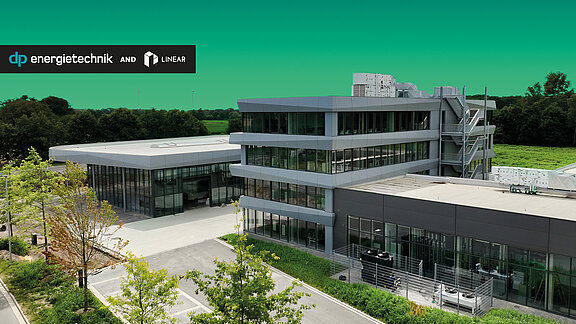
Original image – dp Campus: © dp Energietechnik GmbH
Since construction began in April 2023, an innovative hub for research, business networks, and renewable energy has been taking shape on the 30,000-square-meter site on Schildarpstraße in Gescher—featuring 7,100 square meters of floor space for offices, research facilities, storage, a workshop, and an exhibition area. As part of the project, which was completed in summer of 2025, dp Energietechnik implemented Building Information Modeling (BIM) and relied on LINEAR software to carry out efficient MEP design.
The "dp Campus New Energy and Innovation" is located on the A31—known as the “Energy Avenue”—in the western part of Münsterland and is designed to serve as a pioneering hub for the energy sector.
The term “campus” does not refer to a traditional building complex but rather conveys the idea of a shared space for exchange, innovation, and knowledge transfer. The combination of company headquarters, open rental spaces, and an infrastructure specifically designed for cooperation creates a vibrant network. The dp Campus thus serves as a knowledge sharing platform.
The striking and technically impressive architecture of the campus brings together companies, universities, and startups, fosters collaboration and innovation, and brings modern renewable energy technology to life. In addition to office, exhibition, and storage space for rent, the campus offers room for research, networking, and joint projects aimed at advancing the future of energy.
The open cubature with varying building heights not only gives the campus a distinctive silhouette but also reflects the functional diversity and openness of the design concept. Seamless integration into the surrounding landscape creates a harmonious interplay between architecture and nature—a conscious choice designed to make sustainability tangible not only in technical terms, but also in terms of design.
For the team at dp Energietechnik, the campus was more than just a traditional construction project: It was a pilot project in which the newly established BIM department was able to apply its entire service portfolio under real-world conditions for the first time. From digital design to on-site execution and model-based coordination, the team gained valuable knowledge, experimented, and took on responsibility—despite challenges such as limited BIM experience among most project partners.
As an integral project partner, dp Energietechnik is not only a technical building services planner but also a technically skilled partner working alongside design and architectural firms. The goal is constructive collaboration—with technical depth, digital expertise, and clear added value for the entire design team.
The software used also plays a particularly important role—most notably LINEAR. As the technical backbone of building services design, the software was not only a functional tool but also a key partner in the advancement of internal processes and the professionalization of digital methods.
This article shows why the dp Campus project can serve as a blueprint—for the use of BIM in medium-sized businesses, for a new culture of collaboration between design and execution, and for a building world that takes sustainability seriously. The dp Campus demonstrates how all of this can be achieved—with all the opportunities and challenges that such a pioneering project entails.
Design Methodology & BIM Application
The decision to plan the dp Campus using Building Information Modeling (BIM) was made back in 2019—long before the first sod was turned. At dp Energietechnik, we knew that if we wanted to design sustainable building systems, we also had to consistently digitize our own design processes. This vision was put into practice with the establishment of a dedicated BIM department.
During the project, BIM was not only used in the draft and execution design but was also an integral part of the entire construction process. The project deliberately relied on established software solutions: Autodesk Revit formed the basis for modeling, while LINEAR served as the central tool for MEP design—from heating and cooling load calculations to pipe network and ventilation design to hydraulic balancing.
Despite the high degree of digitization, collaboration was not cloud-based—a conscious decision to limit complexity during the pilot stage. Cooperation with the contractors followed the traditional approach but was based on the provided models. In some cases, model-based data from the trades was also fed back into the central MEP model.
While the building services were planned entirely model-based, BIM was only partially implemented in the structural engineering phase for economic reasons. Nevertheless, it became apparent that: A hybrid approach can also create added value if it is used strategically. The use of IFC formats enabled flexible collaboration across different trades.
The project thus became a practical learning environment—for the team, the processes, and the companies involved. BIM was not seen as an end in itself, but rather as a tool for making design and execution more efficient, transparent, and sustainable. Several construction partners also took the opportunity to gain their first experience with the model-based approach. That's how the dp Campus already lived up to its purpose as a hub for collaboration, knowledge sharing, and collective innovation during its construction.
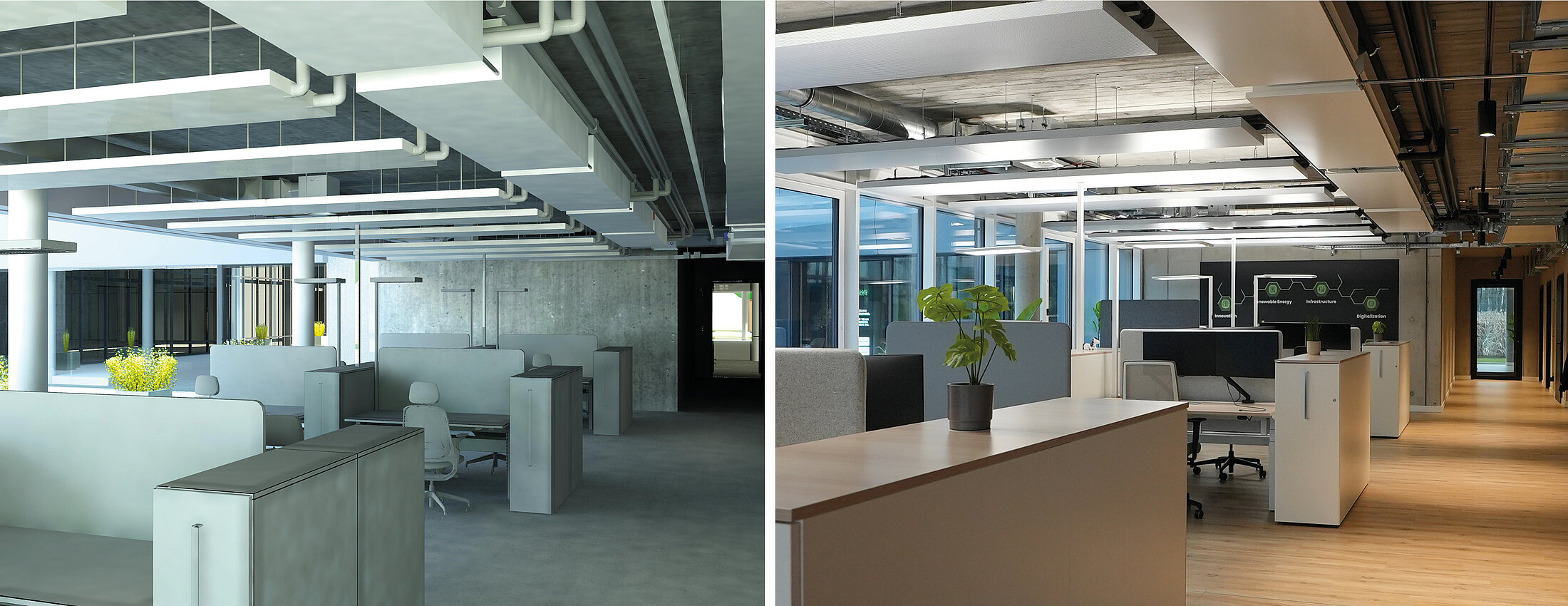
Building Services Engineering – Innovative and Sustainable Solutions
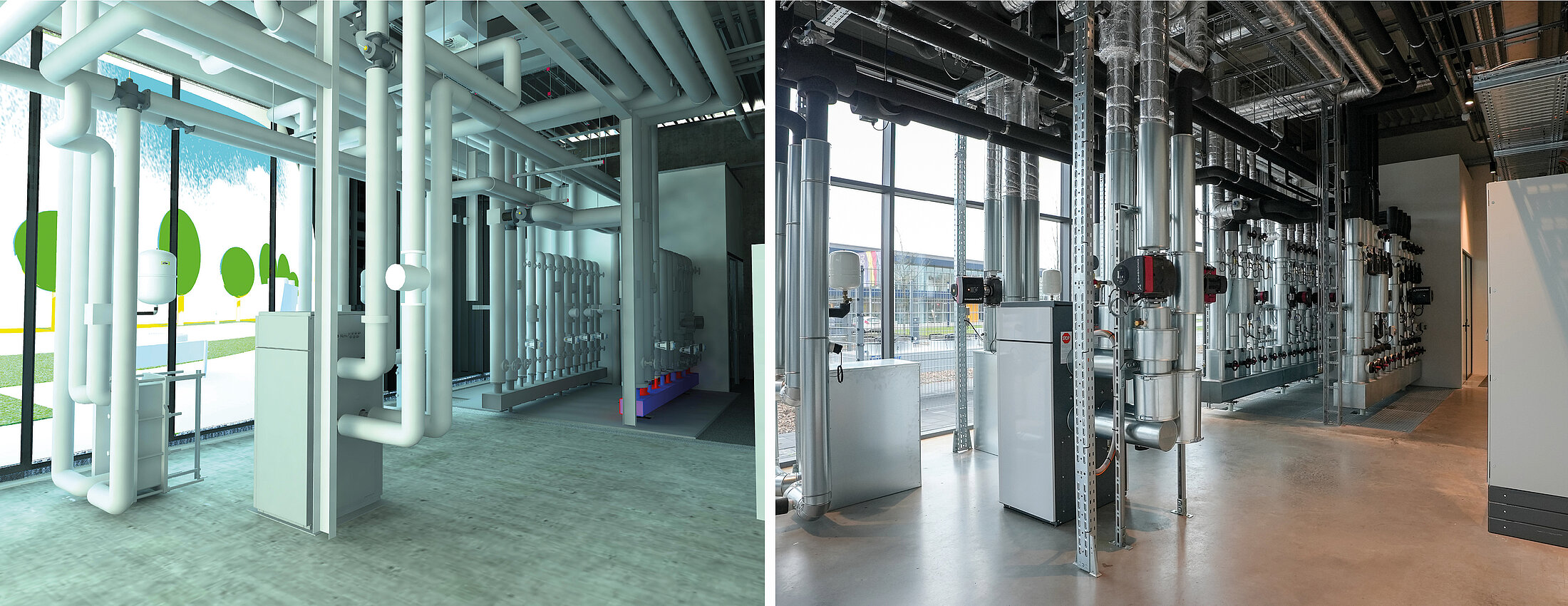
The building services systems at the dp Campus are a central component of the overall sustainability concept – technically sophisticated, energy-efficient, and geared toward sustainability. From the design stage onward, great attention was paid to the integration of renewable energy systems and smart utility solutions.
All systems – from ventilation and cooling to lighting – are integrated into a central building management system that operates using sensors and real-time data. A good example of this is the custom-designed smart desk lamp in the office. Not only does it shine light upward and downward, but it also measures occupancy, noise levels, CO₂ levels, and temperature in the workplace. This information is directly incorporated into the building services control system: The control system automatically responds by providing ventilation, cooling, or dehumidification – without any manual intervention. This not only optimizes energy consumption but also maintains user comfort at a consistently high level.
An overview of the systems in use illustrates how innovative they are:
- 650 kWp of solar panels on the roof, facade, and carports for on-site power generation
- Battery storage for temporary storage and optimization of self-consumption
- 300 m³ of rainwater retention for thermal storage, irrigation of green spaces, and as firewater supply
- Radiant ceiling panels for comfortable, radiant heat distribution with acoustic benefits
- Cooling convectors with four-pipe system for simultaneous cooling and dehumidification with minimal air movement
- HVAC systems with isothermal air flow for energy-efficient ventilation with reduced air exchange
- Dehumidification systems to ensure a constant indoor climate
These systems are not only functional, but also part of an overarching supply concept designed for maximum sustainability and self-sufficiency. The charging infrastructure, with 40 charging stations for e-mobility, is powered directly by the photovoltaic systems, further reducing the carbon footprint. The goal was to achieve the highest possible degree of self-sufficiency – both in terms of energy and operation.
Ambitious requirements were also set for energy efficiency and indoor climate: The building meets the KfW-40 standard, which was achieved through a low air exchange rate, efficient control systems, and a well-designed combination of active and passive measures.
Building services engineering thus makes a significant contribution to the building’s overall performance—not only in terms of energy consumption and operating costs, but also in terms of user comfort, flexibility, and futureproofing. It is an integral part of the campuses concept and shows how technical systems and architectural design can go hand in hand.
Digitalization & Innovation
The implementation of the dp Campus was not only a design project, but also a technological innovation project. Particularly in the field of building services engineering, it became clear how digital tools and precise preliminary design can significantly improve quality and efficiency on the construction site.
One key element, for example, was the consistent use of the Hilti MT System (MT) – a modular rail system for mounting all building services components. This system enabled flexible, weld-free installation directly on-site and was specifically designed to meet the requirements of the dp Campus: visible, transparent routing of all technology – from power and information technology to HVAC.
This conscious decision was not only based on aesthetic reasons. It primarily served the educational concept of the campus: Technology shouldn't be stashed away; it should be a part of the experience. This allows interested visitors to gain a direct understanding of the complex technical infrastructures – an important contribution to the clear communication of knowledge and the promotion of technical understanding.
To achieve the desired clean look, maximum precision was required. Every drilled hole had to be precise; every beam had to be positioned accurately – design errors were not an option.
This goal was achieved through the use of a semi-automatic drilling robot, the Hilti Jaibot, which drilled 6,500 holes with minimal error based on digital plans. The combination of model-based design, automated implementation, and carefully considered mounting technology ensured an exceptionally high standard of execution – both technically and aesthetically.
Another key element was the use of virtual reality (VR) in the design and control phase. The building was inspected several times using VR glasses in order to identify potential collisions, space problems, or design inconsistencies at an early stage—some of which had gone undetected on the screen. Preliminary design with LINEAR proved to be a decisive factor for success: It enabled a technically sound, visually verifiable, and optically coordinated implementation of the building services down to the last detail.

Cooperation and Organization
The successful implementation of the dp Campus was not just a question of technology, but above all the result of effective cooperation between design, execution, and software partners. As the coordinating specialist for building services engineering design, dp Energietechnik was responsible for the technical design and was also involved in parts of the implementation.
Communication within the project took place primarily via Microsoft Teams – a pragmatic approach that has proven effective in regional settings and among small and medium-sized enterprises. Classic BIM coordination with a central data environment (CDE) was deliberately not implemented in order to keep the thresholds for participation low for the partners involved. Instead, dp Energietechnik provided the models on which the executing companies based their execution plans. In some cases, the model-based data from the trades even flowed back into the central building services model – a first step toward bidirectional collaboration.
Even though the project was not coordinated entirely in the cloud, integrating the BIM data into the subsequent project phases was a key objective. This involved processing the models for purposes such as audit documentation and maintenance schedules – e.g. for elevators or building services components that require regular maintenance. The handover of a digital twin for facility management was prepared in order to support the operation of the building in a data-based and transparent manner in the long term.
The dp Campus thus demonstrates that even without a comprehensive BIM infrastructure, a high degree of digitalization is possible if collaboration is clearly structured, roles are well distributed, and tools are used sensibly.
Experiences and Lessons Learned for the Department and the Industry
For dp Energietechnik, the dp Campus was not just a construction project, but a real milestone in the company's own development. As the first project to be planned and supported entirely with the involvement of the newly established BIM department, it offered the opportunity to test digital processes under real conditions – with all the challenges and success factors that such a pioneering project entails.
One of the biggest challenges was dealing with the limited BIM experience of many project partners. A conscious decision was made to take a cooperative approach: through collaboration and open communication, BIM was discovered together – not as an obligation, but as an opportunity. This approach paid off and led to constructive cooperation that continues to have an impact even after the project has ended.
A key factor for success was the clear internal structure: All relevant roles – from BIM manager to BIM author and construction coordination – were bundled in the BIM department. This enabled quick decisions, consistent models, and close integration of design and execution.
For dp Energietechnik, the project led to a huge increase in expertise. The experience gained at the campus is already being applied in new projects, for example, in two follow-up projects with two- and five-story buildings in the region. These are implemented in partnership with or on behalf of design offices.
At the same time, internal processes were streamlined, standards were defined, and collaboration with software partners such as LINEAR was further developed.
The project also serves as inspiration for the region: As one of the first BIM projects of this scale in the Münsterland region, the dp Campus demonstrates that digitalization and sustainability are not a question of company size, but rather a question of having the courage to break new ground. This makes the project a blueprint for other design offices and companies that want to embark on the path to a digital future.
Conclusion
The dp Campus New Energy and Innovation has created a place that goes far beyond its structural function. It serves as an innovation platform, a learning environment, and a practical testing ground all at once – for modern energy technology, digital design, and new forms of collaboration.
For dp Energietechnik, the project was a step toward responsibility. The campus became a test case for the company's own BIM expertise and the starting point for a new design culture based on openness, efficiency, and sustainability.
The fact that BIM is still in its early stages in many German companies is largely due to a lack of standards, unclear responsibilities, and a German fee ordinance for architects and engineers that barely addresses model-based design. However, projects such as the dp Campus show that change is possible when courage, expertise, and the right tools come together.
One such tool partner for dp Energietechnik was the LINEAR software, which impressed not only with its technical depth, but also with its practicality and support in everyday use. It helped to precisely plan, visually review, and efficiently implement complex building services systems, thus becoming the digital backbone of a project that can serve as a blueprint for the industry.
The dp Campus is therefore not just a building, but a visible sign of change – in building services engineering, in the construction industry, and in the Münsterland region.
Are you designing a similar project or looking for a cooperative partner for building services engineering? We would be delighted to invite you to a personal meeting or visit to our dp Campus – please contact us.

dp Energietechnik GmbH is a leading provider of renewable energy solutions with over 50 years of experience in design, implementation, and support of sustainable energy systems.
Today, the headquarters are located on the dp campus in Gescher in the Münsterland region (North Rhine-Westphalia). From here, over 100 employees work on solutions for the energy transition – for customers in agriculture, forestry, industry, and local governments.
They design and implement integrated systems for generating and storing heat, cooling, and electricity.
Further information is available on the company website at:
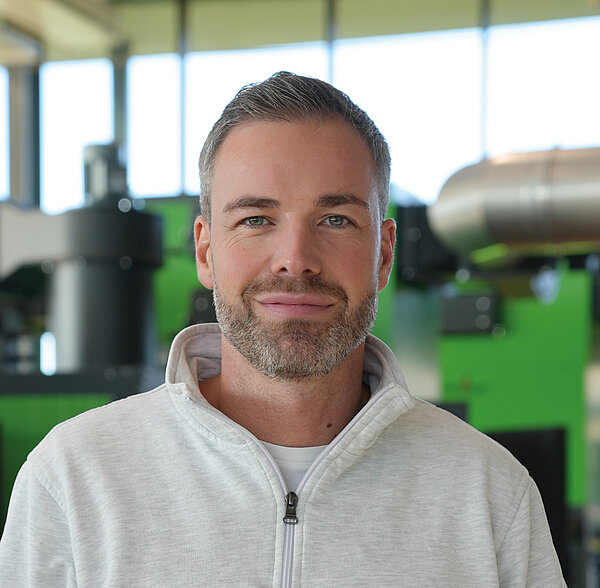
Tobias Picker
CEO of
dp Energietechnik GmbH