You are here:
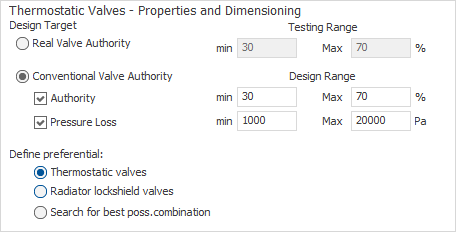
Design target
Valve authority describes the ratio between pressure loss of valve cones and the total pressure loss of the flow path or regulating section.
You can use the valve authority for the thermostatic valves to specify the test range (real valve authority) or the range in which the respective valve is to operate (dimensioning range, for setting conventional valve authority).
The most suitable thermostatic valve is selected from the preselection of valves (Dialog Valves). If only one thermostatic valve has been selected, there is no variation for dimensioning and valve authority can not be varied.
The following steps may improve the valve authority:
-
Selecting a smaller xp-value for the existing valve
-
Selecting a valve with finer adjustments
-
Reducing pressure losses within the flow path (velocity and R-value)
Real valve authority
Enabled: Pressure losses from the valve presetting (pre-throttling) are not added to the authority of the valve, but only to the pressure loss across the valve cone itself, i.e. the proportion that actually regulates. The pressure loss of the pre-throttling is added to the connected network (regulating section, upstream).
Conventional valve authority
Enabled: The total pressure loss of the valve including pre-throttling is used to determine the valve authority. You can either set the authority in % or set absolute pressure losses in Pa. If you activate authority and pressure loss simultaneously, the higher value is used as the limit value.
Define preferential:
When using radiators, it is adjustable which valves are primarily used by the program. Either the thermostatic valve, the radiator lockshield valve or the best possible combination of both valves is set as a priority.